Extra: FELT
FELT is a balanced multi-level card counting system using three count values: +1, +2, and -2. It gives the five core low cards (3–6) a stronger +2 signal than Hi-Lo while maintaining a balanced structure, allowing True Count conversion for precise betting decisions.
Hi-Lo counts all low cards (2–6) as +1 and high cards (10–A) as -1, making it the most common beginner system. FELT raises 3–6 to +2 for stronger signals on the most favorable low cards, and lowers 10 and A to -2 to preserve balance. The trade-off is higher tracking difficulty than Hi-Lo, requiring you to handle different count magnitudes at dealing speed.
FELT Card Values
| Card | Count |
|---|---|
| 3–6 | +2 |
| 2, 7 | +1 |
| 8, 9 | 0 |
| 10, J, Q, K, A | -2 |
True Count Conversion
FELT is a balanced system (RC returns to 0 after a full deck), so True Count conversion is required. TC = RC / remaining decks — the same formula as Hi-Lo. However, because the count range is wider (-2 to +2), the absolute values of RC and TC will be larger than Hi-Lo for the same card distribution.
Insurance
| Situation | Basic Strategy | Deviation |
|---|---|---|
| Dealer A | No Insurance | Take insurance when TC >= +6 |
Surrender Deviations
| Player Hand | Dealer | Deviation |
|---|---|---|
| 15 | 10 | Surrender when TC >= 0 |
| 15 | A | Surrender when TC >= +2 |
| 15 | 9 | Surrender when TC >= +2 |
Hard Hand Deviations
| Player Hand | Dealer | Basic Strategy | Deviation |
|---|---|---|---|
| 16 | 10 | H / R | Stand when surrender unavailable and TC >= 0 |
| 15 | 10 | H / R | Stand when surrender unavailable and TC >= +4 |
| 16 | 9 | Hit | Stand when surrender unavailable and TC >= +4 |
| 16 | A | Hit | Stand when surrender unavailable and TC >= +4 |
| 13 | 2 | Hit | Stand when TC >= -1 |
| 13 | 3 | Hit | Stand when TC >= -2 |
| 12 | 2 | Hit | Stand when TC >= +3 |
| 12 | 3 | Hit | Stand when TC >= +2 |
| 12 | 4 | Stand | Stand when TC >= 0; Hit when TC < 0 |
| 12 | 5 | Stand | Stand when TC >= -1; Hit when TC < -1 |
| 12 | 6 | Stand | Stand when TC >= -1; Hit when TC < -1 |
Double Deviations
| Player Hand | Dealer | Deviation |
|---|---|---|
| 11 | A | Double when TC >= +1 |
| 10 | 10 | Double when TC >= +5 |
| 10 | A | Double when TC >= +7 |
| 9 | 2 | Double when TC >= +1 |
| 9 | 7 | Double when TC >= +3 |
| 8 | 5 | Double when TC >= +4 |
| 8 | 6 | Double when TC >= +2 |
App Simulation Stats
The result below runs Hi-Lo and FELT each for 500,000 rounds. Hi-Lo uses Bet Ramp 4/8/12/16/20 and FELT uses 3/6/9/12/15. Hi-Lo shows ROI 0.55%, EV / 100 of 18.7, and SD / 100 of 580.49; FELT shows ROI 0.57%, EV / 100 of 24.78, and SD / 100 of 686.31.
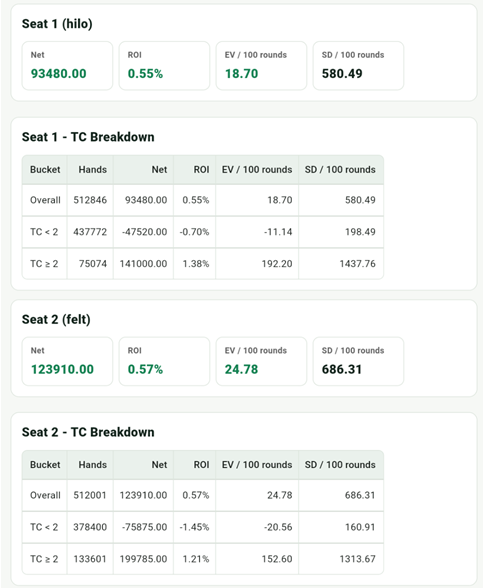
Reading these numbers directly as a head-to-head comparison has limited meaning, because the two systems use different TC scales and different bet ramp structures. What the numbers do reflect is a key trait of FELT: its wider count range (−2 to +2) causes TC to swing more sharply, which naturally produces a higher SD / 100. When the deck turns favorable, FELT detects it with a stronger signal — which is also why its EV in favorable zones can be higher — but the same amplification applies to downswings as well.