Hi-Lo Counting
Card counting is not memorizing every card. It estimates the density of high cards remaining. The two main uses are adjusting bet size and applying deviations.
Hi-Lo Card Values
| Card | Count |
|---|---|
| 2-6 | +1 |
| 7-9 | 0 |
| 10、J、Q、K、A | -1 |
App Training Example: How RC Adds Up
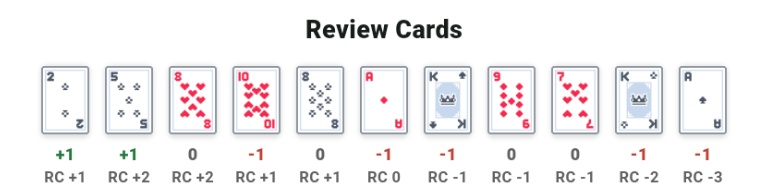
Running Count starts at 0 and updates with each exposed card based on Hi-Lo values. In this example, 2-6 count as +1, 7-9 count as 0, and 10, J, Q, K, A count as -1. After adding them up, the final RC is +2.
RC / TC
Running Count (RC) updates with every exposed card. True Count (TC) = RC / decks remaining. TC standardizes edge strength across different shoe depths.
TC Calculation Examples
In practice, first estimate how many cards remain, then convert that to decks remaining. Since one deck has 52 cards, TC is roughly RC divided by (cards remaining / 52).
| Situation | RC | Cards Left | Decks Converted | TC | Interpretation |
|---|---|---|---|---|---|
| Early Shoe | +5 | 286 cards | 5.5 decks | +0.9 | The edge is just starting to appear; the signal is still weak. |
| Middle Shoe | +7 | 168 cards | 3.2 decks | +2.2 | High-card density is more noticeable, so bet levels deserve attention. |
| Late Shoe | +8 | 94 cards | 1.8 decks | +4.4 | With fewer cards left and a high RC, the betting signal is stronger, but variance also increases. |
How to Use Counting Signals
- Higher TC means the remaining shoe has a higher density of high cards.
- High TC is commonly used to raise bets.
- Some hands switch from basic strategy to a deviation when TC reaches the threshold.
Card counting is usually not illegal, but casinos may still refuse service. This site and app are for learning probability and strategy, not for encouraging gambling.