Extra: KO
KO (Knock-Out) is an unbalanced card counting system. Its main advantage is that it does not require converting to True Count — you use the Running Count directly for betting and deviations, making it simpler to execute at the table than Hi-Lo.
Hi-Lo is a balanced system: one full deck counted from start to finish brings RC back to 0, so you must divide RC by the remaining decks to get True Count. KO counts 7 as +1 instead of 0, which adds a net +4 per deck, so the RC does not return to zero after a full deck. This imbalance means the RC itself carries information about deck penetration, eliminating the need for division and allowing direct RC-based decisions.
KO Card Values
| Card | Count |
|---|---|
| 2–7 | +1 |
| 8, 9 | 0 |
| 10, J, Q, K, A | -1 |
Compared to Hi-Lo, the only difference in KO is that 7 changes from 0 to +1. All other card values are identical.
IRC (Initial Running Count)
Because KO is unbalanced, RC ends at +4 per deck rather than 0. To make RC thresholds consistent across different deck counts, a starting IRC is used. IRC = -4 × number of decks, so for a 6-deck shoe IRC = -24. This shifts the starting RC negative to offset the imbalance.
The KO training mode in the app supports setting a starting RC so you can practice with the correct IRC for any deck count.
Insurance
| Situation | Basic Strategy | Deviation |
|---|---|---|
| Dealer A | No Insurance | Take insurance when RC >= +3 |
Surrender Deviations
| Player Hand | Dealer | Deviation |
|---|---|---|
| 15 | A | H17: surrender when RC >= +1; S17: surrender when RC >= +2 |
| 15 | 9 | Surrender when RC >= +2 |
| 14 | 10 | Surrender when RC >= +3 |
Hard Hand Deviations
| Player Hand | Dealer | Basic Strategy | Deviation |
|---|---|---|---|
| 16 | 10 | H / R | Stand when surrender unavailable and RC >= 0 |
| 15 | 10 | H / R | Stand when surrender unavailable and RC >= +4 |
| 16 | 9 | Hit | Stand when surrender unavailable and RC >= +5 |
| 13 | 2 | Hit | Stand when RC >= -1 |
| 13 | 3 | Hit | Stand when RC >= -2 |
| 12 | 2 | Hit | Stand when RC >= +3 |
| 12 | 3 | Hit | Stand when RC >= +2 |
| 12 | 4 | Stand | Hit when RC < 0 |
| 12 | 5 | Stand | Hit when RC < -2 |
| 12 | 6 | Stand | Hit when RC < -1 |
Double Deviations
| Player Hand | Dealer | Deviation |
|---|---|---|
| 11 | A | Double when RC >= +1 |
| 10 | 10 | Double when RC >= +4 |
| 10 | A | Double when RC >= +4 |
| 10 | 8 | Double when RC >= +4 |
| 9 | 2 | Double when RC >= +1 |
| 9 | 7 | Double when RC >= +3 |
Pair Split Deviations
| Pair | Dealer | Basic Strategy | Deviation |
|---|---|---|---|
| 10,10 | 5 | Stand | Split when RC >= +5 |
| 10,10 | 6 | Stand | Split when RC >= +4 |
App Simulation Stats
Below is a 100,000-round comparison of Hi-Lo and KO. Hi-Lo uses Bet Ramp 2/4/6/8/10 (TC-based), while KO uses RC thresholds −4 / 0 / 3 / 7 mapped to bet sizes 2 / 4 / 8 / 12. In this result, Hi-Lo achieves ROI 0.24%, EV / 100 of 5.05, and SD / 100 of 302.50, while KO achieves ROI 0.21%, EV / 100 of 4.49, and SD / 100 of 325.88. KO shows slightly lower EV and slightly higher SD / 100; the gap is modest but consistent with the trade-off of skipping TC conversion.
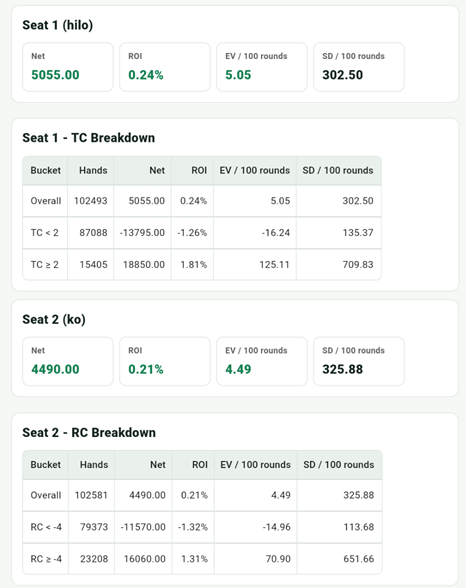
The practical advantage of KO is the removal of the True Count conversion step. Under standard table conditions, this makes KO notably easier to execute accurately, especially for players still building counting speed. The EV difference versus Hi-Lo is real but small — for many players, the execution reliability gained from skipping the division outweighs the edge loss.